۱۳۹۶ مرداد ۱۷, سه‌شنبه

المقاومة تكشف معلومات صادمة عن عميل لبناني للحرس الثوري


http://www.almadaen.com.sa/253592/ 


المقاومة تكشف معلومات صادمة عن عميل لبناني للحرس الثوري


كشفت المقاومة الإيرانية، مساء (الأحد 6 أغسطس 2017م)، أن وزارة مخابرات ملالي إيران، تعمل على إعادة إنتاج عميلها محمد علي الحسيني، وإعادة استخدامه لتسويقه في دول مختلفة والأوساط العربية من أجل استخدامه ضد المقاومة الإيرانية، لا سيما بجانب عملاء النظام، في باريس.
وأوضحت المقاومة، في بيان لها، أنه سبق وتم الكشف عن عمالة هذا الملا لوزارة المخابرات، وقوة القدس الإرهابية، والفرع اللبناني لقوات الحرس وظهوره بين أقذر عملاء وزارة المخابرات، مبينة أن هذا الأمر يأتي كرد فعل متسرع وخائف لمخابرات الملالي على المؤتمر السنوي العام للمقاومة الإيرانية، في بيان لجنة الأمن ومكافحة الإرهاب في 9 يوليو 2017.
وأضافت، أن هناك أكثر من خطة جديدة لوزارة المخابرات فيما يتعلق بهذا الملا العميل، وهي كالتالي، حسبما وصلتهم من داخل البلاد.
خطط وسيناريوهات
أعلنت المقاومة الإيرانية، أن وزارة المخابرات أمرت الملاء الحسيني، إخفاء علاقاته مع العملاء الآخرين قدر المستطاع للحول دون مزيد من فضحه وفقدان مصداقيته، ولذلك فانه تجنب وضع صور وتسجيل لقائه بالعملاء يوم 8 يوليو في باريس على حسابه في الفيسبوك وتويتر، صوره مع العملاء مرفقة طيا.
وأشارت إلى أنه من أجل تبرير زيارته لباريس في يوليو الماضي أعلن الملا الحسيني في عمل تضليلي في مقابلة مع بعض الصحافة العربية، أنه قد قام بتلك الزيارة للبحث عن “عوامل وجذور الإرهاب” بدعوة من “مجموعات فرنسية وألمانية”، بينما كانت الزيارة مرتبة بالكامل من قبل وزارة المخابرات التي كانت قد دفعت نفقاتها ولا تمت بصلة لمزاعمه المثيرة للضحك.
ونوهت أن هذا العميل الذي كان يمتنع عن إجراء مقابلة، وإبداء الرأي ضد نظام الملالي وحزب الله، منذ العام الماضي وبذريعة محظورات أمنية، عاد وبأمر من وزارة المخابرات ومن أجل تبييض وجهه، والتوغل في الدول والأوساط العربية، ليصدر بيانات ويجري مقابلات ضد ولاية الفقيه وحزب الله، انه تكتيك مكشوف لوزارة المخابرات التي تحاول رسم وجه معارض لعملاء النظام لإعطاء مصداقية لهم.
وأكدت أنه خلال الأسابيع الماضية قامت وزارة المخابرات بتكثيف الاتصالات بين الملا الحسيني، وعملائها وعناصرها منها في باريس وبروكسل وبيروت، وكلفت الملا اللبناني بزيارة بروكسل بالقيام وبمساعدة عدد من العملاء المأجورين الأجانب، وعدد من العملاء المكشوفين من أمثال قربان علي حسين نجاد، وغلام رضا صادقي جبلي، وداود باقروند، وبتول سلطاني بهدف إحباط المعارضة الواسعة، لأعضاء البرلمان الأوروبي والبرلمان البلجيكي لانتهاكات حقوق الإنسان في إيران ودعمهم للمقاومة.
ولفتت إلى إن وزارة المخابرات تعتزم تأسيس مركز في أوروبا باسم هذا الملا العميل، وتوظيف عدد من الموظفين في هذا الصدد لكي ينشط ضد مجاهدي خلق، ومناصريهم وحماتهم، خاصة بين العرب تحت غطاء مكافحة الإرهاب.
واستطردت أنه بحسب خطة وزارة المخابرات، من المقرر أن ينشط الملا الحسيني مع عدد من المأمورين للمخابرات الإيرانية، ممن يدعون كذبا مدافعين عن المواطنين العرب المغلوب على أمرهم، ضد المقاومة الإيرانية ويصورون مجاهدي خلق معادين للمواطنين في الأهواز، بصفتهم أناسا يحملون أفكارا شوفينية.
وتابعت أن وزارة المخابرات كلفت هذا الملا اللبناني بتقديم بعض آخر من عملاء وزارة المخابرات كعناصر معارضة لدى الدول والأوساط العربية.
تاريخ الملا الحسيني
ذكرت المقاومة الإيرانية أن الملا الحسيني، قد قضى في السابق عقد من الزمن في مدينة قم، وأثناء ذلك كان عضوا في حزب الله اللبناني، وبعد مغادرة إيران واتخاذ مواقف ضد حزب الله، أعلن عن تضامنه مع منظمة مجاهدي خلق الإيرانية، والتزم بمواجهة الإرهاب، والاستبداد الديني المتمثل في نظام ولاية الفقيه في إيران، مؤكدًا أنه يعتبر أي اقتراب أو إقامة علاقة مع هذا النظام وعملائه، خيانة كبرى ، وفق ما قاله في الميثاق الموقع عليه بتاريخ 28 أغسطس 2007.
وبيّنت أنه خلال هذه السنوات، وبينما كان مجاهدو خلق في مخيمات أشرف وليبرتي، يعيشون تحت حصار لا إنساني وظروف صعبة، وتلبية لطلباته الملحة التي كان يتقاضاها من أجل الدعم المالي والمساعدة لحوزة بني هاشم في لبنان، ولدعم الشيعة ضد النظام الإيراني، قدّمت المقاومة مساعدات مالية له، وعندما اعتقل في لبنان وكان في السجن، تبنّى مجاهدو خلق بتسديد جميع التكاليف الخاصة بالإجراءات القضائية، واختيار المحامين ورعاية عائلته ووفّروا غطاءًا سياسيا له، الى أن نكث ميثاقه وعهده بكل صراحة، وأعلن ذلك في رسالة الكترونية أرسلها يوم 13 آذار مارس2017 واعتبر الميثاق لاغيًا.
واستطردت أن هذا العميل (الملا الحسيني) واصل ابتزازه اليومي لأخذ المال من مجاهدي خلق، وهدد بأنه سوف يترك المجاهدين على حالهم فقط إذا ما دفعوا له مبلغ 30 ألف دولار خلال أسبوع واحد، إلا أن الأمور انتهت بقطع العلاقات معه بعد ذلك.
وثائق دامغة
وأكدت المقاومة أن لجنة الأمن ومكافحة الإرهاب التابعة للمقاومة الإيرانية، تمتلك وثائق الدامغة لعمالة الملا الحسيني، وأعماله الابتزازية، قابلة لتقديمها لأي محكمة، محذرة من المؤامرات القذرة لمخابرات الملالي، وقوة القدس عبر هذا العميل المذكور ضد المقاومة الإيرانية ودول الجوار.


#Iran: Rouhani’s exclusion of women as seen by the press

The issue of women’s exclusion from #Rouhani’s new cabinet has been also covered by the state-run press.
The Ghanoon daily published a cartoon criticizing women’s being denied the opportunity for political participation. Under a big banner shown in the cartoon, men are the only candidates whose names are listed, while women are sitting on the sideline and have no prospect for participating.

#Iran: No Information About Political Prisoners in Gohardasht Prison Raises Concern

#Iran: No Information About Political Prisoners in Gohardasht Prison Raises Concern

http://www.ncr-iran.org/en/news/human-rights/23327-iran-no-information-about-political-prisoners-in-gohardasht-prison-raises-concern 


NCRI - The families of political prisoners and prisoners of conscience in Gohardasht prison in Karaj express their concerns about forced transfer of these prisoners to a super-security ward.
According to reports, political prisoners were recently forcefully transferred from Ward 12 to the super-security Hall 10, Ward 4, of Gohardasht prison after beating and mayhem.
A political prisoner's wife, while expressing concern, writes a note at the Instagram: “My Husband (Hamid Babaii), and 52 other prisoners, are locked up in a large hall. We have no news about his fate and the fate of his cellmates for more than two weeks. According to reports from other wards, my husband and four other detainees have been admitted to the prison infirmary. All 53 people are on hunger strike. We also do not know the accuracy of the news. In any case, lack of news leads us to worry. All families are worried and get the news from each other.”
Meanwhile, a group of women prisoners at Evin Prison have also expressed concern about the forced transfer of political prisoners in Gohardasht Prison, the statement issued by these women, stated:
“We were informed that political prisoners and prisoners of conscience in Rajaei Shahr (Gohardasht) prison were suddenly and forcefully transferred to another ward in this prison. This is while they were not allowed to take their personal belongings and even their medication with them. Unfortunately, during the past 7 days, all communications of the prisoners have been disconnected, even the families of these prisoners who are currently incarcerated in the women's ward of Evin prison have not been able to call prison to prison to obtain some news about their fate, which causes grave concern for families and, therefore, all of us.”
“Hereby, we, female political prisoners and prisoners of conscience in Evin Prison, protest against the situation of Gohardasht prisoners, and express our grave concerns. We request the possibility to make phone calls and communication as well as family visits according to the previous procedures and in due time.”
Hall 10 of Gohardasht prison has ten security cameras and sixty four surveillance systems and an advanced control room. According to former political prisoners and witnesses, Hall 10 and Ward 4 of the Hall is similar to solitary confinement glass cells.


The Nationwide Protests of Nurses in Different Cities of Iran

Iran: Propaganda Against PMOI/MEK, Focusing on the 1980s

ANALYSIS: Are sanctions on Iran a sign of shifting US policy?

ANALYSIS: Are sanctions on #Iran a sign of shifting US policy?

https://english.alarabiya.net/en/features/2017/08/06/ANALYSIS-Are-sanctions-on-Iran-a-sign-of-shifting-US-policy-.html


Disclaimer: Views expressed by writers in this section are their own and do not reflect Al Arabiya English's point-of-view.
The enactment of a comprehensive sanction bill and designating the Iranian Revolutionary Guard Corps (IRGC) as a Specially Designated Global Terrorists (SDGT) by US lawmakers targeting Tehran’s military and terrorist arm, is a significant signal of shifting US policy in reaction to Iran’s destabilizing role in region. The regime is beginning to realize that the Obama era is over.
This alteration in US policy acts as a catalyst and facilitator of change inside of Iran. However, the main factor and grass roots of change are inside Iran.
This pivot point for a policy change has an accelerating role and is influenced by the ineradicable behavior of the Islamic Republic and on the other hand the will of people’s resistance to achieve in such policy.
Now, the question remains on the Iranian regime’s reaction and choice of direction to the new sanction bill. In such crises, the Iranian regime has a track record of buying time (delaying tactic) and taking one step forward and one step backward, as witnessed in previous nuclear negotiations.
If Obama’s policy of appeasement and concessions was decisive, Tehran would have been forced to step further back from their evil approach. But this did not happen, and the regime was constantly revived through newly provided funds and sanction relief. Instead, Tehran expanded its destabilizing role and terrorist activities in the region.
The adoption of new sanctions so far has put Iran in a shocking stage. If these sanctions are seriously applied and extensively implemented, Tehran will be pinned to make an ultimate decision.

Retreating or challenging

Iran faces widespread and profound social dissatisfaction, parallel to economic insolvency and serious crises. It understands the language of force and lacks the ability to challenge. The most likely option for Tehran is to kill time and continue delaying.
To prevent the regime’s highly cheating skills, the best policy is to enforce and maximize pressure. Tehran is a fundamentalist and rebellious regime without any legitimacy. It is incapable in changing its behavior. According to Iranian Supreme Leader Ali Khamenei, changing the regime’s behavior will ultimately bring the regime down.
Therefore, there will be no transformation or reform from such a regime. The Iranian people are keen towards overthrowing this regime and the comprehensive and extensive sanctions on IRGC is aligned and in support of their will for regime change.
The social conditions in Iran have come to a boiling point and the opposition movement has the potential and an upper hand. The path forward is social rebellions to overthrow this regime.
During the 2009 uprisings Iranians were chanting: “Obama, Obama are you with us or the mullahs?,” as they called in vain for international support.

The policy shift

The Iran policy shift has its effect inside the regime and they have been vocal about it. In this regard the “Resalat daily”, regime’s controlled paper, in its July 31, 2017 issue, pointing to the change in the international affairs towards the Iranian regime states: “Behind the sanctions belies a boycott campaign. There will be an overthrowing in a soft, sophisticated and silent way,” a recent piece in the state outlet Resalat daily reads.
Ahmad Jannati, Chairman of the Guardian Council, also raised deep concerns. “[Khamenei’s] most important concern is the fear of overthrow,” and “the enemy is seeking regime change from within,” he said.
Iran won’t have the same fate as Iraq and Syria since there is an organized democratic and powerful opposition. This alternative is the National Council of Resistance of Iran, a democratic platform which the People’s Mojahedin Organization of Iran (PMOI/MEK) is the main force. On July 1st the NCRI demonstrated its strength and abilities by gathering hundreds of thousand supporters in Paris, all seeking regime change in Iran.
The NCRI demands a boycott in international diplomatic and economic relations and expelling Iranian regime representatives from international assemblies. The IRGC and affiliated proxies must also be evicted from the region.

The appeasement policy

On a side-note, the Iranian regime feeds off its lobbies’ propaganda and advocates promoting yet again the appeasement policy, aimed at justifying and legitimizing beneficial relations with Iran. The regime’s lobby argues the international community should cooperate with Tehran as there is no alternative other than war. This absurd propaganda is promoted while the IRGC has been in war in Syria, Iraq, Lebanon and Yemen.
In same regards, US Secretory of States Rex Tillerson recently insisted on cooperation with Russia to tackle terrorism and end the Syria war.
“Iran’s military influence, the direct presence of Iranian military forces inside of Syria, they must leave and go home, whether those are Iranian Revolutionary Guard forces or whether those are paid militias, foreign fighters that Iran has brought into Syria” he said.
All evidence shows the only path to peace and stability in Iran and the Middle East is to support the NCRI and pressure Tehran through extensive sanctions.
The NCRI issued a statement welcoming the new law imposing sanctions against Iran and the Revolutionary Guards, emphasizing its immediate implementation meticulously without exception.
Furthermore, NCRI President-elect Mrs. Maryam Rajavi underscored these sanctions must be implemented immediately against all individuals and entities involved in executing and torturing the Iranian people, especially those directly involved in the 1988 massacre of over 30,000 political prisoners.
Rajavi also emphasized that the people’s right of resistance for regime change must be recognized. She also views these collective ultimately resulting in stability and peace in the region.

ANALYSIS: Iran’s quest for nuclear weapons and regional domination

ANALYSIS: #Iran’s quest for nuclear weapons and regional domination

https://english.alarabiya.net/en/perspective/features/2017/08/07/ANALYSIS-How-to-tackle-Iran-s-Middle-East-bellicosity.html 


Besides their policing duties within Iran’s borders, the Iranian Revolutionary Guard Corps (IRGC) was put in charge of the country’s clandestine nuclear program in the 1980s, taking full charge of the regime’s quest for nuclear weapons. With its hard-line commanders determined to lead the most powerful army in the Middle East, it needed sophisticated weapon systems to achieve this, and nuclear weapons soon became an obsession.
The full achievements made in the construction of these devices, will never be allowed to come to light, until those weapons are ready to be unveiled to the world; although, throughout the years, much intelligence has come to light to show the IRGC are well on course to achieving their goal.
With nationalistic fervour having always been at the forefront of the Guards revolutionary goals, they would never give up the quest for such a weapon. They feel that by possessing such an arsenal of weapons, they could steer Iran toward full control of the Middle East, as well as a handy tool for warding off an attack from the US or Israel, who would fear the catastrophic retaliation from Iran over such an attack.
With the Guards in total control of the procurement of weapons of mass destruction, they have supervised the construction of a vast network of underground facilities across Iran. The Iranian regime has claimed for decades that their nuclear program will be used to produce isotopes for medical purposes, and not to pursue a bomb. But with a vast amount of intelligence to prove otherwise, with all evidence pointing to a nuclear weapons program, it has to be assumed that Iranian boffins have been working on such weapons since the early days of Khomeini setting up the Islamic Republic of Iran.

Substantial documentation

There is substantial documentation to show that the Iranian regime has been for many years seeking equipment and expertise with which to build a nuclear device. Over the years, vast amounts of intelligence have come from many sources when it comes to Iran’s nuclear program.
In 2005, it came to light through the National Council of Resistance of Iran (NCRI), how Iran was in possession of quantities of polonium-210 and beryllium, plus the know-how to make a “neutron generator” that is needed to trigger a fission chain reaction, all key elements that are essential in the construction of a nuclear weapon.
With so much secrecy behind its nuclear program, plus the fact that underground nuclear facilities have been uncovered by the Iranian opposition group the MEK, and indisputable evidence that the Iranians have been building nuclear capable missiles, which they have been testing in recent months, this all seems to point toward the regime seeking a full nuclear capability for its military forces, and they could reach their goal in the very near future.
Iranian President Hassan Rouhani during a meeting with UN nuclear chief Yukiya Amano, in Tehran, Iran, Sept. 20, 2015. (AP)

The deal

So as far as International Atomic Energy Agency (IAEA) policing its nuclear program as part of the Iran Deal is concerned, with the Iranian regime refusing the IAEA full access to secret bunkers such as Parchin, and its nuclear program just stalled and not dismantled, the agreement isn’t worth the paper it is printed on.
At the time of the Iran Deal, it was strongly believed that Iran’s nuclear weapon was close to completion, with already an arsenal of missiles capable of carrying them stored in underground bunkers ready to launch, many aimed at the Gulf states, and American military facilities in the area.
But such were the derisory sanctions placed against the regime by the West, headed by the Obama administration; Iran’s nuclear program has in effect only been suspended, which makes it possible for its boffins to restart it at any time. So, with Iran having received continued assistance from North Korea, a country that already has a functional nuclear device, as well as the capability to fit one to a missile, the scenario of full cooperation becomes ever scarier.

Defense systems

Also, through the millions of dollars handed back to Iran, the regime has strengthened both its internal defenses through the application of new air defense systems, as well as updating arms and equipment for its armed forces, making it a much bigger threat to its neighbors than ever before. As well as this, the amount of money it has had returned through the Iran Deal, has helped tremendously in bankrolling its military campaigns in Iraq, Syria and Yemen.
So, by participating in this new game of diplomacy, which it has been playing very well, Iran’s clerical leadership is planning to be in the nuclear deceit game for the long haul. If they can keep the West playing along with them, the mullahs will be able to build up Iran’s inner security, and with its new strengthened military, it will have the ability to repel both internal dissent, and any outside invader, showing its neighbours that it is a country to be both feared and reckoned with.
Then no sooner is its economy booming, with its armed forces the most sophisticated in the Middle East, and its air defences second to none, the regime will finish building its long sought after nuclear weapon. Having reached the stage where it feels no outside force can stop it, the true belligerence of its leadership will take over, and their long sought after nuke will be revealed to the world.
But at least, now that Donald Trump is in charge of the White House, fresh sanctions have been put in place; but only time will tell how far the new president will go in confronting Iran, and in what form this confrontation will take.

ANALYSIS: How to tackle Iran’s Middle East bellicosity

ANALYSIS: How to tackle #Iran’s Middle East bellicosity

https://english.alarabiya.net/en/perspective/features/2017/08/07/ANALYSIS-How-to-tackle-Iran-s-Middle-East-bellicosity.html

Thanks to years of Western appeasement in the face of Iran’s belligerence across the Middle East, evidence of Tehran’s dangerous footprints are now visible in several countries across the region, including even Saudi Arabia’s Eastern Province.
The Trump administration, however, has made it quite vivid its adoption of a firm approach. This stance, signaled in the historic May conference in Riyadh, is long overdue and should be enhanced by Washington supporting the Iranian people’s desire for regime change.

A history of devastation

Iran has a long record of hostility against neighboring countries and US interests in the Middle East. The 1983 bombings targeting the US Embassy and barracks in Beirut, the Khobar Towers attack in 1996, all climaxed in the support Iran provided for Shiite proxies and the Sunni Taliban in their campaign against US-led coalition forces in Afghanistan and Iraq.
In parallel form, the Lebanese Hezbollah and Hamas, two known terrorist groups, have for over 30 years enjoyed contributions from Tehran to fuel sectarianism throughout the Middle East and carry out terrorist attacks.
The Obama administration handed Iraq over to Iran in a silver plate through a strategic mistake of prematurely pulling out all US troops. This paved the path for Iran to further export its “revolution” through a convenient medium of extremist proxies.
The West can literally be accused of standing aside and watching Iran’s aggressive policy. This has rendered a slate of countries, including Afghanistan, Bahrain, Iraq, Saudi Arabia, Syria and Yemen feel threatened and/or left utterly devastated from Iran’s meddling on their soil.
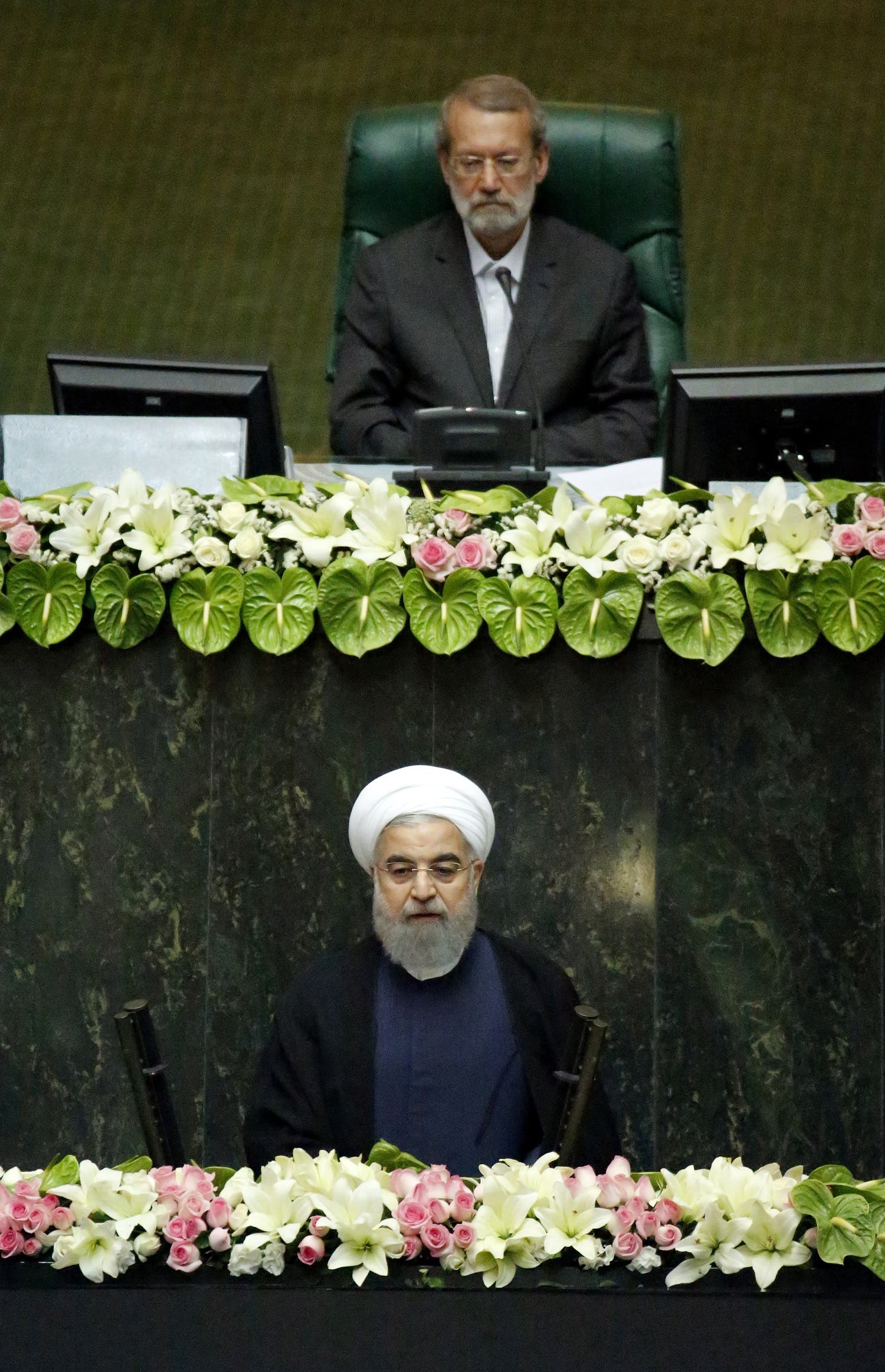
Iran’s Parliament Speaker Ali Larijani (top-R) attends President Hassan Rouhani’s swearing-in ceremony in Tehran, on August 5, 2017. (AFP)

Troubling activities

Of late, Iran has been reported to send further weapons and narcotics to Yemen’s Houthis. These drugs are sold to provide income for Iran’s supported militias on the ground in the flashpoint country south of Saudi Arabia, Tehran’s archenemy in the region.
Members of Iran’s Revolutionary Guards (IRGC) are present in Yemen also to instruct and guide the Houthis in assembling weapons smuggled into the country by Tehran.
“For the last six months the Islamic Revolutionary Guards Corps (IRGC) has begun using waters further up the Gulf between Kuwait and Iran as it looks for new ways to beat an embargo on arms shipments to fellow Shi'ites in the Houthi movement,” Reuters cited Western and Iranian sources.
“Using this new route, Iranian ships transfer equipment to smaller vessels at the top of the Gulf, where they face less scrutiny. The transshipments take place in Kuwaiti waters and in nearby international shipping lanes, the sources said.”
The Iranians are also taking provocative measures against the US Navy in the same region recently, viewed by analysts as actions to learn the limits of US President Donald Trump. On July 26th an armed Iranian patrol boat closed within less than 150 meters of the USS Thunderbolt, yielding back only in response to warning shots fired by a US Navy ship.
Such developments are reasons why Trump contacted his French counterpart Emmanuel Macron “to explore how to increase cooperation in addressing the ongoing crises in Syria and Iraq and countering Iranian malign influence,” according to a White House readout.

Positive steps forward

Despite the utterly wrong decision of EU foreign policy chief Federica Mogherini visiting Tehran for Iranian President Hassan Rouhani’s inauguration, the Trump administration is sending push-back signals and making Iran learn its aggressions will not go without cost.
This is a necessary and welcomed shift in Washington’s foreign policy.
President Trump has signed into law a strong bipartisan Congressional initiative imposing strict sanctions on Iran, Russia and North Korea. The IRGC is now considered a Specially Designated Global Terrorist group. Considering the Guards’ control over at least 40 percent of Iran’s entire economy, this raises the stakes for companies considering doing business with Tehran.
It would be wise to reconsider investing in Iran’s $400 billion economy and ponder placing one’s bets in other regional countries, or say, the United States’ $19 trillion establishment.
And in news that most certainly raised eyebrows in Tehran, Iraqi Shiite cleric Muqtada Sadr visited Saudi Arabia recently and called for the controversial Iran-backed Popular Mobilization Units in his country to be dissolved now that the Islamic State has been defeated.
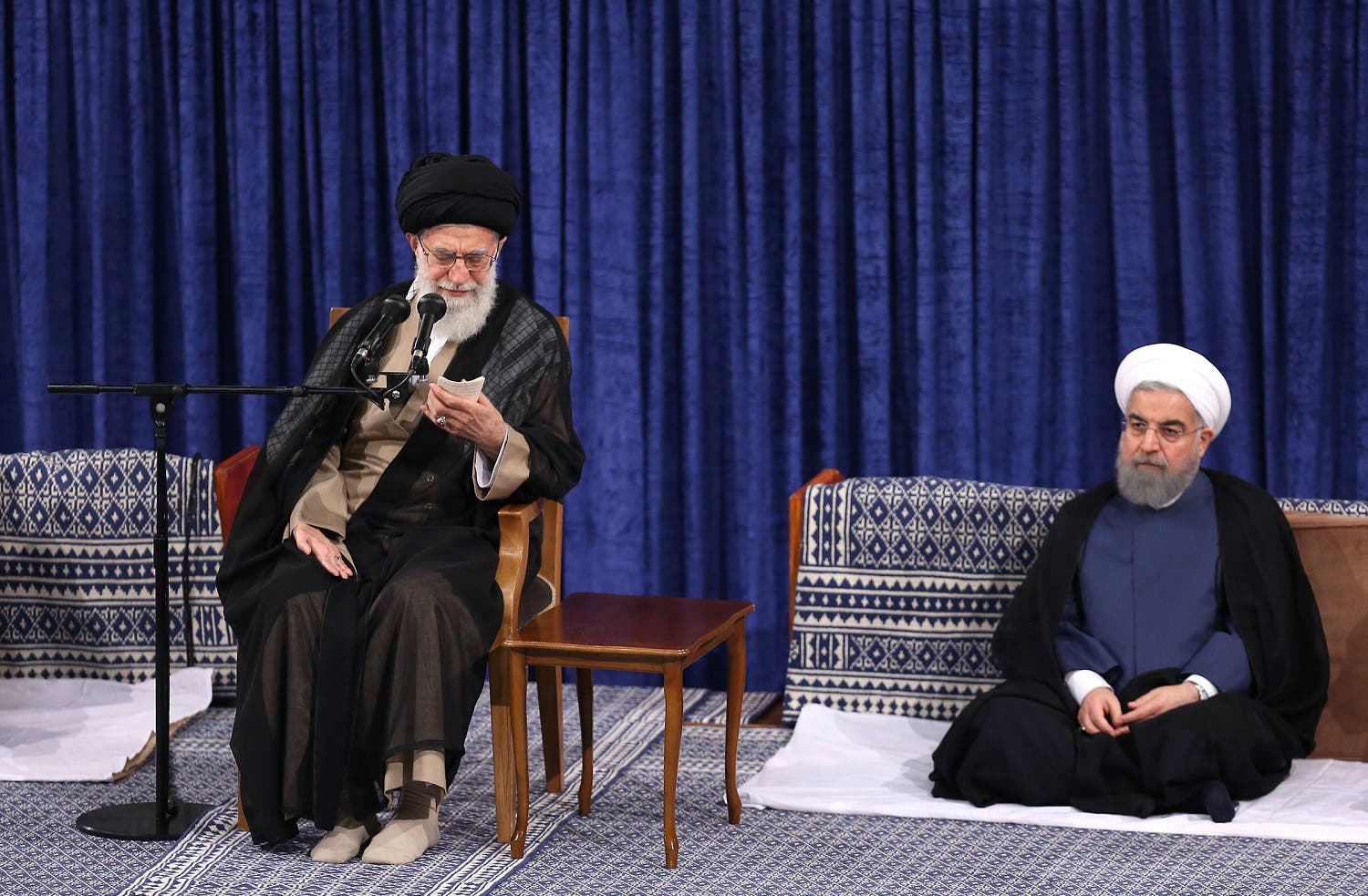
Supreme Leader Ayatollah Ali Khamenei, left, speaks in the official endorsement ceremony of President Hassan Rouhani, right, in Tehran, on Aug. 3, 2017. (AP)

The nuclear deal

High hopes were placed in the nuclear deal sealed between the P5+1 and Iran, which Obama hoped to leave behind as his foreign policy legacy.
Two years down this road it has become vivid that Iran’s behavior has not changed, to say the least. In fact, Tehran’s support for Hezbollah and other extremist entities have escalated. Iran’s role in the Middle East, namely Syria, Iraq and Yemen have been horrifically destructive.
The Trump administration can lead the international community in instituting the first real and effective initiative against the Iranian regime.
Any trade with Tehran should hinge on:
- the regime halting all executions and human rights violations,
- withdrawing their forces from Syria and Iraq, and severing any ties and support for terrorist groups,
- completely stopping missile activities, especially ballistic missile production and tests,
- ending all nuclear initiatives and providing true “anytime, anywhere” access to all suspected sites, including military facilities.
Moreover and parallel to recent sanctions, which must be executed immediately and without any loopholes, the Iranian people’s organized opposition, resembled in the National Council of Resistance of Iran, should be recognized. This will pave the path for regime change by this coalition without war or military intervention.
Failure in this regard is tantamount to aiding Tehran’s regime.