۱۳۹۶ مرداد ۱۵, یکشنبه

Europe must not turn a blind eye to Iran’s human rights abuses

Europe must not turn a blind eye to #Iran’s #human rights abuses

https://english.alarabiya.net/en/features/2017/08/04/Europe-must-not-turn-a-blind-eye-to-Iran-s-human-rights-abuses.html 


Amnesty International has just published a 94-page report entitled “Caught in a web of repression: Iran’s human rights defenders under attack.” It details 45 specific instances of what the organization has described as a “vicious crackdown” coinciding with the supposedly moderate presidency of Hassan Rouhani, who begins his second term in office this week.
The overall takeaway is that Iranian authorities have repeatedly diminished the standards by which they accuse and convict activists and dissenters of national security crimes, while also increasing the severity of punishments that are meted out to those same people. The abusive nature of those punishments was reinforced by new revelations that emerged alongside the Amnesty International report, mainly regarding the Islamic Republic’s notorious overuse of the death penalty.
Iran has long maintained world-leading rates of execution, and the violence and repression of the past few years have been reflected in a pattern of hangings that includes periodic spikes during which dozens of people are put to death in a single month. Last month saw just such a spike, with at least 101 death sentences being carried out, to say nothing of those that might have gone ahead in secret.
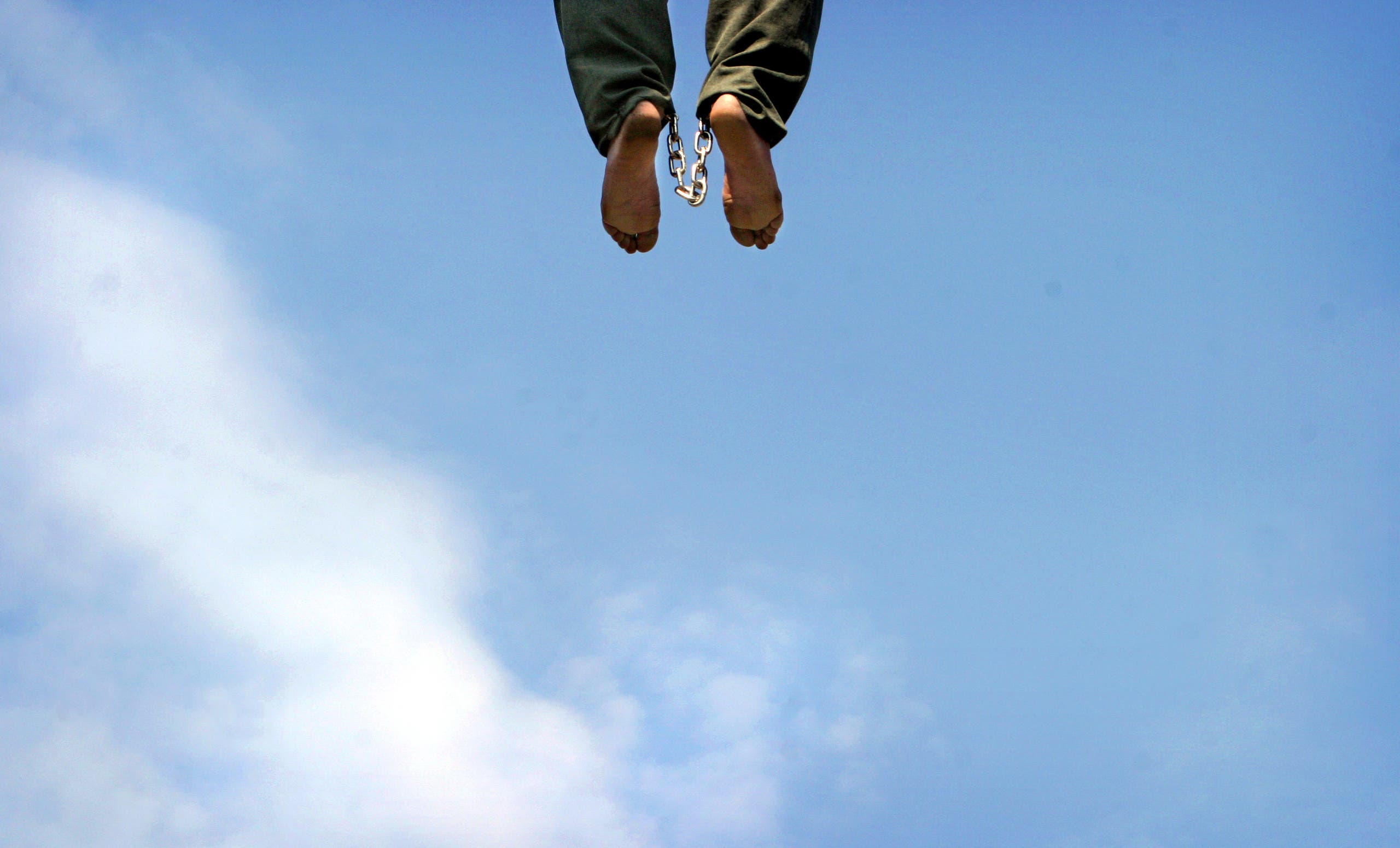
The Iranian Human Rights Organization announced that the Iranian authorities executed over one hundred people during the month of July. (File photo: Reuters)
In Iran, political prisoners are sentenced to hang with some frequency, usually on the basis of vague, religious charges like “enmity against God” or “insulting the sacred.”

Repressive, theocratic regime

Executions speak to the repressive nature of the theocratic regime, which has only grown worse in the era of Rouhani, when the government is fractured between two factions, neither of which represents reform. Maryam Rajavi, the president of the leading coalition of Iranian dissidents, the National Council of Resistance of Iran, responded to the new death penalty figures by saying, “Beset by crises and fearing popular uprisings, Iran’s ruling theocracy has found no other way out but to escalate repression especially by mass and arbitrary executions.”
The NCRI statement went on to recommend that the international community disregard economic and political incentives to expand relations with the Islamic Republic, and instead undertake measures to hold its officials accountable not only for recent crackdowns and executions, but also for long-neglected past crimes, like the massacre of some 30,000 political prisoners in the summer of 1988.
Naturally, being “beset by crises” and the possibility of popular overthrow, the regime is deeply fearful of this sort of pressure, which would imply Western readiness to stand behind a domestic uprising in Iran, and to aid it by making sure that Tehran is not free to carry out reprisals against dissenters as it sees fit.

Absurd claim 

Last month, Iran’s own so-called human rights monitor, Javad Larijani, made the absurd claim that the country does not hold any political prisoners. Immediately thereafter, foreign diplomats in Tehran were taken on a tour of the notorious Evin Prison, but human rights investigators were kept far away from the public relations stunt, while the diplomats were kept far away from wards that are known to house political prisoners almost exclusively.
Iranian Foreign Minister Javad Zarif has made similarly bold, easily ridiculed statements asserting the country’s innocence. But with or without the new Amnesty International report, no one with a modicum of knowledge of the Islamic Republic should ever take such claims seriously. Unfortunately, Zarif and other members of the Rouhani administration appear to be masterful at putting a friendly face on Iran’s clerical regime, even as its domestic abuses and foreign provocations continue to escalate.
Justice will only be achieved when the international community has the courage to reject Iran’s absurd, anemic denials and to instead respond with new economic and diplomatic pressure to the regime’s human rights abuses.
Struan Stevenson
This is the only explanation for the fact that some Western officials, including European Union foreign policy chief Federica Mogherini, agreed to attend this week’s re-inauguration of President Rouhani. These decisions were profoundly misguided, insofar as any Western presence at an Iranian state function presupposes that the relevant officials are turning a blind eye to human rights abuses that are not only continuing but escalating on Rouhani’s watch.
It is simply inconceivable that any of those officials are unaware of the information being shared by Amnesty and others. The most charitable explanation for their actions is that they do not hold Rouhani personally responsible for the crackdowns and are willing to offer their support to his administration in the hope that it will finally, after four years in office, begin to promote serious domestic reforms.
But if this is their thinking, it is painfully naïve. Rouhani has never been anything other than a loyal servant of the regime that tortures its citizens and imprisons them for upwards of 10 years simply for protesting previous human rights abuses. Soon after taking office in 2013 amidst the applause of Western officials, Rouhani thoroughly turned his back on human rights by appointing Mostafa Pourmohammadi, a leading figure in the 1988 massacre, as his justice minister.
Such officials must be brought to justice, lest the Iranian regime be convinced that it can get away with thousands of unlawful killings and still enjoy the presence of friendly European faces at its state functions. Justice will only be achieved when the international community has the courage to reject Iran’s absurd, anemic denials and to instead respond with new economic and diplomatic pressure to the regime’s human rights abuses.

Iran expands its terrorist sponsorship in the Balkans

#Iran expands its terrorist sponsorship in the Balkans

http://www.americanthinker.com/blog/2017/08/iran_expands_its_terrorist_sponsorship_in_the_balkans.html#ixzz4ot8vZMgJ 


The U.S. Congress's recent bill of sanctions on Iran mainly cites the Iranian regime's terrorist activities throughout the Middle East.
The recently released Country Reports on Terrorism 2016 by the U.S. State Department says:
Iran continued its terrorist-related activity in 2016, including support for Hizballah, Palestinian terrorist groups in Gaza, and various groups in Syria, Iraq, and throughout the Middle East. Iran used the Islamic Revolutionary Guard Corps‑Qods Force (IRGC-QF) to implement foreign policy goals, provide cover for intelligence operations, and create instability in the Middle East. Iran has acknowledged the involvement of the IRGC-QF in the conflicts in Iraq and Syria and the IRGC-QF is Iran's primary mechanism for cultivating and supporting terrorists abroad.
The report is strong; however, it does not mention anything on the Iranian regime's terrorist activities in Europe.
Iran's promotion of its brand of Shi'ite Islam, linked with its terrorist-related activities across the Middle East, has been obvious for decades, but such activities in Europe have largely managed to fly under the radar.  The Iranian regime is advancing its presence and resources considerably in Europe, especially in the Balkans.
In 2016, the Iranian regime's Balkans-centered efforts came under scrutiny when an Iranian cleric in Kosovo was charged with financing terrorism and money-laundering through a nominally non-governmental organization he operated.  Kosovar authorities claimed that Hasan Azari Bejandi, charged on July 26, 2016, ran five Shi'ite organizations with links to Tehran.
The umbrella group for the Iranian regime in Europe, including Kosovo, appears to be affiliated with the Al-Mustafa International University, headed by Ayatollah Alireza Aarafi, a member of Iran's Supreme Council of the Cultural Revolution and a Friday Prayers leader in the holy city of Qom.  The university claims that Bejandi is its representative in Kosovo.  Al-Mustafa International University is owned and run by Iranian supreme leader Ayatollah Ali Khamenei.
Last week, non-government organizations and the German media warned the government about the activities of Al-Mustafa-linked organizations in the country.  The federal family minister in Germany, Katarina Barley, was alerted about an Al-Mustafa workshop in Germany funded, wrongly, by her ministry, under the guise of a workshop of the Islamic Community of the Shiite Communes of Germany (IGS).  The minister called the event off.
It demonstrates that Iran's effort to exert influence over the Balkan peninsula and its governments poses a grave security threat.
On March 9, the news media in the Balkans reported that American security agencies saw expanding activities from Iranian intelligence services over the Balkan area.
The U.S. National Security Agency (NSA) has compiled a report on increased activities of Iranian intelligence services in Bosnia and Herzegovina, containing around 650 names of members, mostly from Iran's Revolutionary Guards (IRGC) and Ministry of Intelligence and Security (MOIS).
The report actually covers 15 years of Iranian intelligence agents' activities and is mainly based on information gathered by the Intelligence and Security Agency (OSA) of Bosnia and Herzegovina.
First on the list of Iranian intelligence agents is Hassan Jawad, deputy minister of intelligence in Tehran, according to the report.
During the Bosnian war of the 1990s, Jawad was the IRGC chief for southeastern Europe and then became head of the Department of Central Asia and the Caucasus, according to OSA.
Jawad is also a member of the Iranian-Bosnian Friendship Association Board of Directors, but in reality, he is focused on intelligence work and was a key player in recruiting.
Iran began extending its malign influence in Bosnia back in 1990 as communism collapsed in Yugoslavia.  The mullahs dispatched spies with cash to Sarajevo to grease politicians' palms, advocate radicalism, and recruit and train terrorists.
During the past three decades, Iran has launched consulates in the Balkans for espionage and other covert activities.  The presence of Iranian intelligence agents in Bosnia in Herzegovina has sharply increased since the beginning of 2012, along with the activities of Iranian officials and diplomats.  In particular, Iranian spies were seen visiting the jihadist colony at Gornja Maoča in northeastern Bosnia, which, despite occasional police raids, has operated for years as a more or less open training camp for jihad-minded radicals.
Albania is another Balkan country Iran has targeted in its attempt to create what Reza Shafa, an Iran expert, has called "a foothold in the European continent."  As in Bosnia, the attempted Iranian infiltration of Albania followed the pattern of setting up "charities" and "cultural organizations" that serve as front organizations for the Islamic Revolutionary Guard Corps and the Ministry of Intelligence.  Despite such efforts, however, Iran draws little sympathy in either elite circles or among the general population.  Last year, Albania's government and parliament were in unanimous agreement to allow a large number of members of Iran's democratic opposition group, the MEK, to settle in Albania.
Iran's techniques in training, equipping, and recruiting terrorists across the Balkans through the IRGC is well known.  After the U.S. sanctions against the IRGC, in order to have a safer world, the next step for the civilized world is to join the U.S. sanctions to make them work to evict all the elements of IRGC from its targeted countries in the Middle East and Europe.

Iran: Over 5.5 million women are illiterate

ANALYSIS: Are sanctions on Iran a sign of shifting US policy?

ANALYSIS: Are sanctions on #Iran a sign of shifting US policy?

https://english.alarabiya.net/en/features/2017/08/06/ANALYSIS-Are-sanctions-on-Iran-a-sign-of-shifting-US-policy-.html 


Disclaimer: Views expressed by writers in this section are their own and do not reflect Al Arabiya English's point-of-view.
The enactment of a comprehensive sanction bill and designating the Iranian Revolutionary Guard Corps (IRGC) as a Specially Designated Global Terrorists (SDGT) by US lawmakers targeting Tehran’s military and terrorist arm, is a significant signal of shifting US policy in reaction to Iran’s destabilizing role in region. The regime is beginning to realize that the Obama era is over.
This alteration in US policy acts as a catalyst and facilitator of change inside of Iran. However, the main factor and grass roots of change are inside Iran.
This pivot point for a policy change has an accelerating role and is influenced by the ineradicable behavior of the Islamic Republic and on the other hand the will of people’s resistance to achieve in such policy.
Now, the question remains on the Iranian regime’s reaction and choice of direction to the new sanction bill. In such crises, the Iranian regime has a track record of buying time (delaying tactic) and taking one step forward and one step backward, as witnessed in previous nuclear negotiations.
If Obama’s policy of appeasement and concessions was decisive, Tehran would have been forced to step further back from their evil approach. But this did not happen, and the regime was constantly revived through newly provided funds and sanction relief. Instead, Tehran expanded its destabilizing role and terrorist activities in the region.
The adoption of new sanctions so far has put Iran in a shocking stage. If these sanctions are seriously applied and extensively implemented, Tehran will be pinned to make an ultimate decision.

Retreating or challenging

Iran faces widespread and profound social dissatisfaction, parallel to economic insolvency and serious crises. It understands the language of force and lacks the ability to challenge. The most likely option for Tehran is to kill time and continue delaying.
To prevent the regime’s highly cheating skills, the best policy is to enforce and maximize pressure. Tehran is a fundamentalist and rebellious regime without any legitimacy. It is incapable in changing its behavior. According to Iranian Supreme Leader Ali Khamenei, changing the regime’s behavior will ultimately bring the regime down.
Therefore, there will be no transformation or reform from such a regime. The Iranian people are keen towards overthrowing this regime and the comprehensive and extensive sanctions on IRGC is aligned and in support of their will for regime change.
The social conditions in Iran have come to a boiling point and the opposition movement has the potential and an upper hand. The path forward is social rebellions to overthrow this regime.
During the 2009 uprisings Iranians were chanting: “Obama, Obama are you with us or the mullahs?,” as they called in vain for international support.

The policy shift

The Iran policy shift has its effect inside the regime and they have been vocal about it. In this regard the “Resalat daily”, regime’s controlled paper, in its July 31, 2017 issue, pointing to the change in the international affairs towards the Iranian regime states: “Behind the sanctions belies a boycott campaign. There will be an overthrowing in a soft, sophisticated and silent way,” a recent piece in the state outlet Resalat daily reads.
Ahmad Jannati, Chairman of the Guardian Council, also raised deep concerns. “[Khamenei’s] most important concern is the fear of overthrow,” and “the enemy is seeking regime change from within,” he said.
Iran won’t have the same fate as Iraq and Syria since there is an organized democratic and powerful opposition. This alternative is the National Council of Resistance of Iran, a democratic platform which the People’s Mojahedin Organization of Iran (PMOI/MEK) is the main force. On July 1st the NCRI demonstrated its strength and abilities by gathering hundreds of thousand supporters in Paris, all seeking regime change in Iran.
The NCRI demands a boycott in international diplomatic and economic relations and expelling Iranian regime representatives from international assemblies. The IRGC and affiliated proxies must also be evicted from the region.

The appeasement policy

On a side-note, the Iranian regime feeds off its lobbies’ propaganda and advocates promoting yet again the appeasement policy, aimed at justifying and legitimizing beneficial relations with Iran. The regime’s lobby argues the international community should cooperate with Tehran as there is no alternative other than war. This absurd propaganda is promoted while the IRGC has been in war in Syria, Iraq, Lebanon and Yemen.
In same regards, US Secretory of States Rex Tillerson recently insisted on cooperation with Russia to tackle terrorism and end the Syria war.
“Iran’s military influence, the direct presence of Iranian military forces inside of Syria, they must leave and go home, whether those are Iranian Revolutionary Guard forces or whether those are paid militias, foreign fighters that Iran has brought into Syria” he said.
All evidence shows the only path to peace and stability in Iran and the Middle East is to support the NCRI and pressure Tehran through extensive sanctions.
The NCRI issued a statement welcoming the new law imposing sanctions against Iran and the Revolutionary Guards, emphasizing its immediate implementation meticulously without exception.
Furthermore, NCRI President-elect Mrs. Maryam Rajavi underscored these sanctions must be implemented immediately against all individuals and entities involved in executing and torturing the Iranian people, especially those directly involved in the 1988 massacre of over 30,000 political prisoners.
Rajavi also emphasized that the people’s right of resistance for regime change must be recognized. She also views these collective ultimately resulting in stability and peace in the region.

US and European Countries Join to Criticise Iran's Latest Launch

US and European Countries Join to Criticise #Iran's Latest Launchhttp://www.iranfocus.com/en/index.php?option=com_content&view=article&id=31838&catid=8&Itemid=124

 London, 3 Aug - The United States, along with France, Britain, and Germany has pushed the United Nations Security Council for action, on Wednesday August 2, over the launch of a satellite rocket by the Iranian Regime.

Iran Regime's Plainclothes Intelligence Agents Clash With Girls Who Were Biking


#Iran Regime's Plainclothes Intelligence Agents Clash With Girls Who Were Biking 

https://towardfreedomwithmek.blogspot.al/2017/08/iran-regimes-plainclothes-intelligence.html 


According to reports, plainclothes forces of Marivan Intelligence are constantly patrolling around the lake Zaribar and its entrances.
Plainclothes forces do this in order to prevent women and girls from biking around the Zaribar lake.
According to reports on July 29, plainclothes forces seized several girls' bicycles and got a written commitment that they should no longer enter the Zaribar area by bicycles.
"Bike riding by girls are prohibited in public," the Iranian regime's police force told them to stop bikers.
Police officers seized their bikes after preventing girls from bicycling. Over the past year, law enforcement officers have prevented bicycling women and girls in public places in Marivan several times. The Friday prayer Imam of the regime in the city had said on July 28, 2016: "Riding bicycles in public for women is a sin, and officials and sports and youth departments must provide adequate indoor space for women." Thereafter, a place called "Lady's Park" was dedicated to biker girls in Marivan, where women's rights activists not only did not see this place as a special right for women, but saw it as plans to marginalize and humiliate women. It keeps women away from their basic and human rights.

۱۳۹۶ مرداد ۱۲, پنجشنبه

دعوة لتطبيق قانون العقوبات الجديدة على نظام الملالي وقوات الحرس فورا

دعوة لتطبيق قانون العقوبات الجديدة على نظام الملالي وقوات الحرس فورا

رحبت المقاومة الايرانية بتوقيع الرئيس الآمريكي على مشروع قانون العقوبات الجديدة ضد نظام الملالي وقوات الحرس التابعة له حيث اصبح قانونا نافذًا، وشدت على ضرورة تطبيقه فورا ودقيقا دون استثناء مطالبة الاتحاد الاوربي بانضمام الى فرض هذه العقوبات بدوره. يجب ان لا تترك للنظام والاطراف الاخرى المنتفعة منه اية امكانية للتهرب من هذا القانون. ان طرد قوات الحرس والميليشيات التابعة لها من المنطقة لا سيما من سوريا والعراق يعد خطوة ضرورية لتطبيق هذا القانون وانهاء الحرب والازمة التي عمت المنطقة برمتها.


ان المشروع الذي كان صادق عليه كل من الكونغرس ومجلس الشيوخ الامريكيين باغلبية ساحقة الاسبوع الماضي، يحتوي عقوبات جديدة على نظام الملالي لانتهاكه حقوق الانسان وانتاج الصواريخ الباليستية، وتشمل عقوبات على قوات الحرس والتي تفرض بشكل خاص على قائمة «الارهابيين الدوليين» (SDGT). وقد تمت صياغة هذه القائمة بعد احداث 11 إيلول 2001 بامر من الرئيس الامريكي.


ان ادراج قوات الحرس - باعتبارها المؤسسة المكلفة بحراسة نظام الملالي وكيانه والذراع الايمن للنظام في ممارسة القمع وتصدير الإرهاب والتطرف- في لوائح الإرهاب، هو إجراء كان من المفروض ان يتم قبل عدة سنوات غير ان سياسة المداهنة والمسايرة مع دكتاتورية الملالي تركت المجال والسبيل أمام قوات الحرس والعملاء التابعين لها لصولاتها وتمددها في المنطقة بأسرها.


وعقب المصادقة على هذا المشروع من قبل مجلس الشيوخ الإمريكي، أكدت السيدة رجوي رئيسة الجمهورية المنتخبة من قبل المقاومة الإيرانية : إن فرض العقوبات الشاملة على نظام الملالي يجب أن يكتمل باتخاذ خطوة عاجلة ضد مسؤولي الإعدام والتعذيب المتورطين في مجزرة السجناء السياسيين في العام 1988 وفي مقدمتهم خامنئي زعيم  النظام. ويجب تقديم هؤلاء إلى العدالة لارتكابهم جريمة ضد الإنسانية على مدى 38 عاما.


 إن الحل النهائي للأزمة في المنطقة يكمن في إسقاط نظام الملالي على يد الشعب الإيراني والمقاومة الإيرانية، وأن الإعتراف بأحقية  الشعب الإيراني  في إسقاط الملالي وتحقيق الحرية والديمقراطية في إيران يمثل أكبر مساعدة لإحلال السلام والأمن في المنطقة والعالم.


أمانة المجلس الوطني للمقاومة الإيرانية

المقاومة الإيرانية تحذر من كارثة إنسانية في سجن جوهردشت وتطالب بتحرك دولي فوري

المقاومة الإيرانية تحذر من كارثة إنسانية في سجن جوهردشت والمقاومة الإيرانية تحذر من كارثة# إنسانية في سجن جوهردشت وتطالب بتحرك دولي فوريتطالب بتحرك دولي فوري#

تحذر المقاومة الإيرانية من الخطر الذي يهدد حياة 53 سجينا سياسيا إيرانيا في سجن جوهردشتبمدينة كرج، ممن تعرضوا للاعتداء بالضرب والإساءة وتم نقلهم إلى موقع جديد في الذكرى التاسعة والعشرين لمجزرة السجناء السياسيين.

وتطالب المفوض السامي لحقوق الإنسان، والمقررة الخاصة المعنية بحقوق الإنسان في إيران، بتشكيل لجنة دولية لتقصي الحقائق للنظر في حال السجناء.

وأوضحت المقاومة إلى أن في يوم الأحد 30 يوليو، تعرض 53 سجينا سياسيا في العنبر 4 القاعة 12 في سجن جوهردشت لمداهمة وحشية، وتم نقلهم إلى القاعة 10 في السجن، حيث تجهزت بأكثر من 30 جهازا للتنصت و40 كاميرا مراقبة لغرض الحؤول، دون تسريب الأخبار والمعلومات إلى خارج السجن وتم غلق جميع المنافذ والشبابيك بصفائح معدنية.

كما منع الجلادون، نقل الدواء والحاجات الشخصية ومقتنيات السجناء، مثل الثلاجات والمكيف وجهاز تصفية المياه التي اشتراها السجناء على حسابهم الشخصي، مشيرة إلى تدهور حال عدد من السجناء بسبب عدم الوصول إلى علاجهم وفقدان جهاز التهوية وتم نقل بعضهم إلى مصحة السجن.

وذكرت أن السجناء المنقولونن بدأوا إضرابا عن الطعام للاحتجاج على ممارسة الضغط ومؤامرة النظام ضد حياتهم وسلامتهم وأمنهم، مذكرة أنه بعد شهرين من مسرحية الانتخابات، أذعن روحاني في حملاته الانتخابية بأن البلاد تم إدارتها طيلة 38 عام مضى بالسجن والإعدام، أخذت حملات الإعدام والقمع والتعذيب أبعادًا أوسع.